Table of Contents
History of Ladakh
Kashmir has been focal point of India’s appeasement politics. Since India’s independence, Like Jammu, Ladakh got step-motherly treatment from Delhi. Being a part of J&K princely state, with it’s merger with India, It became India’s part and it was a part of J&K state. Ladakh is extremely important from an strategic point of view and hence it has been eyed by all our neighbours.
In the 1947-48 Indo-Pak war, Pakistan tried to capture Leh, but was defended by the Indian army. The people are inherently extremely peaceful, so much so, that the people refused to use weapons and violence to defend themselves from the Pakistani army. Tibbetian Buddhism is the prominent religion in the region. Let’s us first understand what is modern day Ladakh. It has has 2 districts – Leh and Kargil. Kargil has 90% Shia muslim population and Leh has 80% Buddhist and nationalist. When we say Ladakh, we mean Leh.
1947-1970(s) was a period of extreme negligence and step motherly treatment to Ladakh. Frustration keep growing and to tone it down, Ladakh Hill Development Authority was born in 1974. By the 1980(s), Ladakh Buddhist Association started protest to separate them form J&K and make them a Union Territory and come under Delhi’s rule.
The protests kept growing and by the 1990(s)., communal clashes between Buddhists and Shia Muslims started. After this the demands of separating Leh from Kargil started. Kargil wanted to stay a part of J&K, While Ladakh wanted to be UT. In 1995, Leh was given Leh autonomous hill council and Kargil was gven limited local governance. Ladakh was never acceoted by Delhi, never heard of and the protest continued until 2019, When, With the abrogation of article 370, Ladakh (with Kargil) was given a UT status, completing their long lasting demand, ending the saga.
Post 2019’s Ladakh
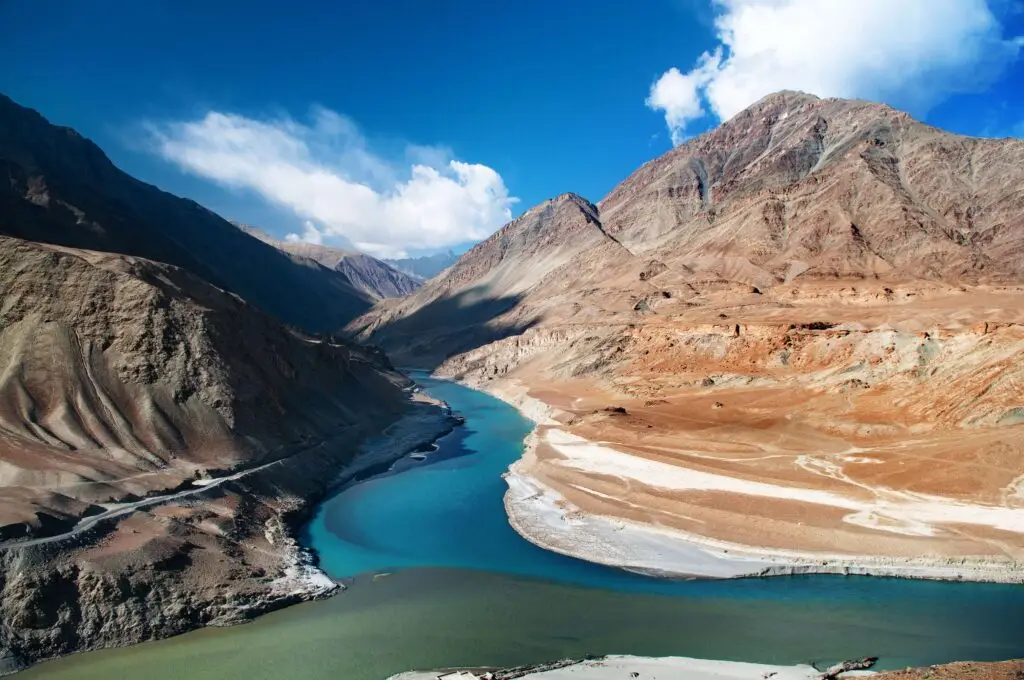
Post 2019, Ladakh was finally acknowledged as an Indian state and accepted by Delhi with open hands. Since becoming a UT, Ladakh has had ~1,670 km of roads newly built or upgraded (blacktopped / metalled). Tourism has increased: from ~279,937 tourist arrivals in 2019, rising to ~531,396 in 2022; then ~525,374 in 2023; ~376,386 in 2024. Besides all these developments, Indian army has significantly increased it’s presence and made Ladakh a strong hold. Jobs, healthcare, society, Ladakh has grown in every aspect post 2019.
Retrospective analysis of Ladakh Violence
1. Everything wrong with the statehood demand
Population : The population of Present day Ladakh is around 3 lakh, 50% of which is Shia Muslim population. The population of Leh is 1.5 lakh, 15% of which being shia muslim. Ladakh’s population density is 3 to 5 people per square km
Borderland Sensitivity : Ladakh shares long, disputed borders with both China (LAC) and Pakistan (LoC). Giving full statehood means granting a locally elected legislature and government more powers, which Delhi fears could complicate defence, land, and foreign affairs management. Inter-connecting with low population, this becomes a deadly cocktail.
Foreign Intervention : China has a power hold over Ladakh’s panchayat’s. Being surrounded by Pakistan and China, The risk of foreign intervention is real and dangerous with a example of Pakistan’s Kashmir’s terrorism and intervention. The foreign intervention and indoctrination stands as one of the biggest threat for Delhi
Demography and Kashmir : Ladakh being bordered by Kashmir and Kargil, The demography change and spread of Islamic indoctrination poses a big threat. The protection of land is a factor in the statehood demand and it will the first to be compromised by interstate migration and spread of indoctrination.
In the end, Statehood will open a Pandora box of problems for Delhi. The statehood demands are reasonable, but not do-able. This demand poses a threat and after we have example’s of northeastern insurgency and Kashmir terrorism problem, This demands seems wrong from the government’s perspective.
2. Deep State, Sonam Wangchuk and BJP’s complacency
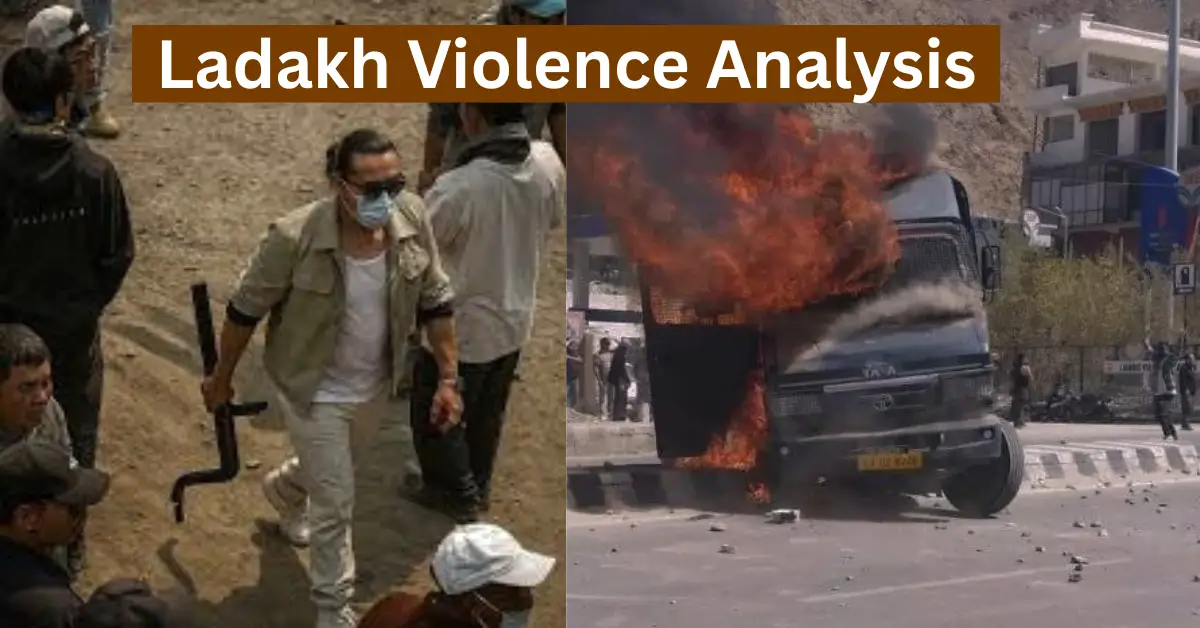
Immediately after 2019 UT status, Statehood demands started growing. Sonam wangchuk being a prominent voice, he started protests during 2020-2022 for the demands of 6th schedule and statehood. Sonam wangchuk was once known for his pro-government stance, now leading the violence in Ladakh. In 2018, 60 hectares of land was alloted to Sonam wangchuk to carry out his developmental projects for the welfare of society.
The terms were clear: pay Rs 14 crore within one year and complete construction within two years. Seven years later, officials say neither condition has been fulfilled, the unpaid amount rose to 37 crore. This led to the cancellation of the lease on 12th September 2025. Though not clearly, But Sonam wanghuck’s actions were questionable from some time, like the Pakistan visit. In Sonam wangchuk’s protest, the politics and cancellation of lease play a role. At the right time, Sonam wangchuk became a deep state asset and tried to instigate violence in the society. Ladakh is peaceful and their demands are not wrong.
3. Decoding toolkit
Toolkit works by creating a reasonable doubt or frustration, growing it into a fault line and then exploiting it. In this case, the bad deeds of Congress. The frustration of 65 years of Delhi’s negligence was the reasonable frustration, on this, People like Sonam wangchuk come like a messiah to give people the rights they were already given in 2019, by evolving the demand of UT to statehood, By brainwashing them over the reasonable frustration. This frustration grew and was exploited by toolkit, neighbours and people like Sonam wangchuk for their benefit.
4. BJP’S Complacency
It is surprising that BJP, known for it’s communication, is now getting trashed by the same. Throughout the handling, of Manipur to now, communication and perception by BJP is getting poor and poor. A simple question : Why did BJP took this whole saga lightly? BJP will have to build it’s own toolkit and a communication strategy to counter these problems. The ignorance by the government and BJP is one of the most important factor that we are seeing violence in one of the most peaceful state in the country, had it been countered better and handled better, this would not have occurred. BJP have to introspect about it’s IT cell, it’s communication and narrative building.
If you read the Government’s press release, It is mentioned that talks between Government and representatives were going from a long time and it has produced results, It is the Government’s responsibility to communicate this with the people. Sometime’s it is more important to show that you are doing something rather then actually doing it. For the ignorance of congress, the toolkit managed to create a narrative and perception against the present government which gave them UT status, and BJP is paying for it.
Possible Solutions
- UT with legislature : Just like Delhi and J&K, Ladakh can be given a given a legislature while being a UT
- 6th Schedule while being a UT : A constitutional amendment can be done, to keep Ladakh’s UT status and make and bring them under 6th schedule
- BJP improving their communication : If BJP improves their communication and works on the ground to convince people and counter’s the toolkit properly, the problem might get solved or tone down at a big level.
Conclusion
This problem can not be taken lightly as any dissatisfaction in the region will lead to foreign intervention. Though reasonable, the statehood demands seems very tough for the government. BJP needs to counter this on multiple levels, handling and countering the toolkit while solving the local issues. This should be taken lightly or as a one time violence, if did, it will be a bigger problem and more difficult to handle.