
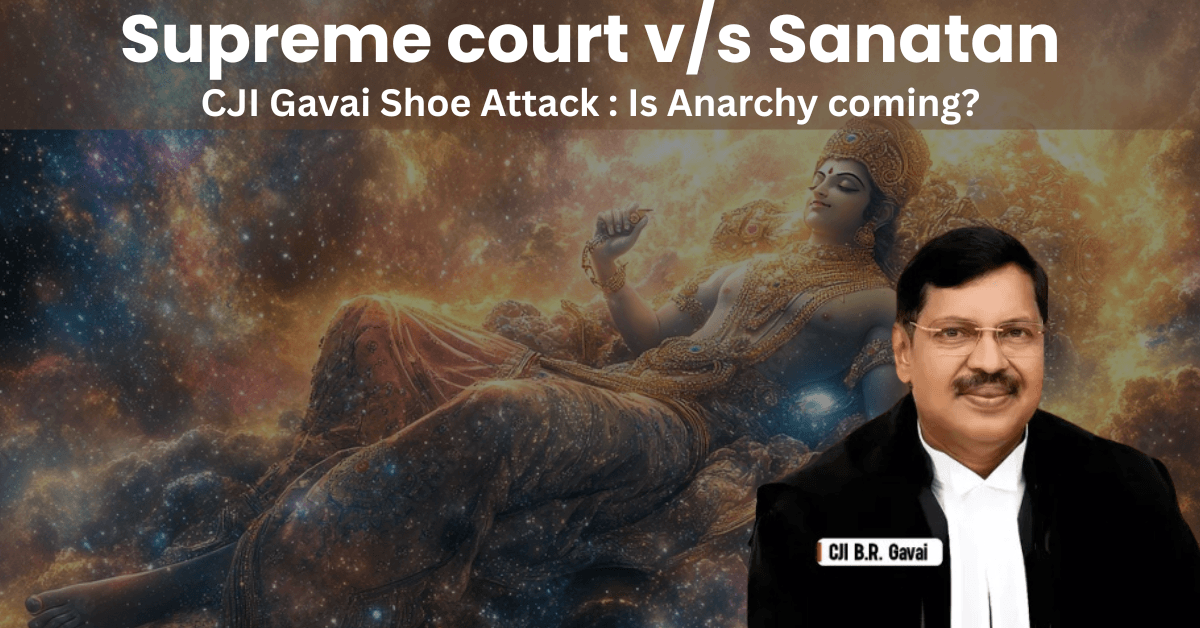
When a shoe was thrown at CJI Gavai in the Supreme Court after his Vishnu remark, it wasn’t just a moment of courtroom chaos – it was a snapshot of something deeper unraveling in India’s public life. The CJI Gavai shoe attack has stirred outrage, memes, and serious reflection on how far dissent, devotion, and disorder have begun to overlap.
What began as a seemingly offhand judicial remark about Lord Vishnu during a hearing quickly escalated into a symbolic act of defiance – a shoe hurled not just at a judge, but at the very idea of institutional respect. As religion seeps into legal discourse and anger replaces argument, we are forced to ask an uncomfortable question: is India slipping into anarchy?
This episode goes beyond one courtroom or one judge. It exposes the growing tension between religion and judiciary, between faith and free speech, and between citizens and the institutions meant to uphold order. To understand what the CJI Gavai Vishnu remark and the shoe attack truly signify, we must look at where authority, outrage, and ideology now collide – and what that collision tells us about the direction of modern India.
Table of Contents
Background & Context: Vishnu Remark and the Court Case
If you missed the original trigger behind the CJI Gavai shoe attack, it started with a case that sounded harmless – a plea for the restoration of a Vishnu idol in Khajuraho. The petitioner claimed the deity deserved to be reinstated in the temple. The Supreme Court bench, led by CJI Gavai, heard the matter like any other cultural-heritage dispute.
During the hearing, CJI Gavai remarked, “Go and ask the deity himself to do something. If you are saying that you are a strong devotee of Lord Vishnu, then you pray and do some meditation” – a line that, didn’t land well outside those walls. Within hours, snippets spread online and outrage snowballed.
Soon after, religious groups accused the judge of mocking Vishnu, and social media debates painted the judiciary as out of touch with cultural sentiment. But beyond the noise lies a truth familiar to anyone in leadership – authority demands both clarity and humility.
The Shoe Attack Incident
Fast forward a few days – tension reached the boiling point. During a Supreme Court hearing, a man in the audience suddenly hurled a shoe toward the CJI B.R Gavai. The object missed, but the symbolism didn’t. The attacker shouted that he was defending Sanatan Dharma against an “insult to Vishnu.”
It was the kind of moment that says more about society than the individual. The CJI Gavai shoe attack wasn’t just about faith – it was about anger, distrust, and a collapsing line between belief and justice.
Within hours, clips flooded social media. Some condemned the act as anarchy in India, others romanticized it as “devotion in action.” The debate showed how easily respect for institutions can turn into performance outrage.
How Court invited the shoe on themselves
Mindset of our Judges
Let’s not sugarcoat it – the mindset of our judges often reflects an ivory tower reality. Years of authority, insulation from everyday accountability, and institutional privilege have created a bubble that many in the judiciary don’t even recognize.
When you sit on a high bench long enough, you stop hearing the noise below. That’s not always corruption in the financial sense, but it is corruption of empathy. The result? Loose tongues, poor optics, and an institutional tone-deafness that alienates the very citizens the court exists to serve.
The Judges, who got the privilege to study in western nation about the law, not only take knowledge from there, but also take with themselves western ideology, western culture and a “bloody Indian” mindset. There is nothing Indian about the Indian Judges.
Combining this with a position of absolute power without any accountability – gives us the Indian judiciary. The Judges focus on sounding intellectual – rather finding solutions to problems. Judges often quote western “Intellectuals” and “philosophers”, but the problem is, it does not solves the problem of India and a common Indian people. There are 5 crore pending cases in judiciary yet, Indian judiciary get’s 170+ holidays, highest in the country.
Indian public has changed, Indian constitution has changed, There have been multiple reforms in India in every discourse, yet Judiciary remains un-touched, getting 170+ holidays which started during the British period.
A fight was started in 1997 to make the judges list their assets in public, but was never entertained by the judges as it violated their “privacy”. In 2009, after public pressure, the court said it did not violated their privacy and a website was made for judges to voluntarily list their assets. Till 2025, no judge voluntarily listed property on that website. Finally, after the Yashwant varma scam, it was made mandatory to list their assets publicly.
When a lawyer called Yahwant varma by his name, without addressing him by the term mi lord or justice, the Judge interrupted him and told him to respect all other judges – “he is still a judge”, the lawyer was told. from being called mi lord to sticking to the post of judge after doing a 200+ crore scam, From not listing assets to saying that social media should be dealt with Iron hand, from slapping fir’s and contempt of court to whoever criticises the judges to quoting western intellectuals – It is nothing but entitlement, and this entitlement gives birth to corruption and loose tongue like the CJI’s remark on lord Vishnu.
Supreme court v/s Sanatan and institutional problem in court’s
If you watch the Supreme Court long enough, you start to feel like you’re watching a startup with too many founders and no unified vision. One bench says one thing, another says the opposite. One judge quotes scripture, another warns against bringing religion into court. And in between, citizens are left wondering: who exactly speaks for justice?
1. Conflicting Benches, Colliding Ideologies
In theory, every bench represents the same Supreme Court. In practice, it often feels like parallel universes.
- One bench upholds a principle of free speech; another restricts it.
- One protects religious sentiment; another dismisses it as subjective hurt.
- Sometimes, a smaller bench even contradicts the spirit of a Constitution Bench ruling.
That’s not intellectual diversity – that’s judicial schizophrenia. It’s what happens when an institution becomes too personality-driven and too little process-driven.
Just like a startup where every co-founder has their own “vision,” the court starts losing consistency, and with it, credibility.
2. Controversial Decisions and Public Perception
The Supreme Court vs Sanatan narrative didn’t arise from thin air. It came from a trail of verdicts which were very much a result of appeasement, fear and a anti-sanatan ideology:
- The Ayodhya verdict gave the disputed land for the Ram temple but also “compensated” Muslims with alternate land – an odd legal symmetry that satisfied no one fully.
- In the Nupur Sharma row, comments made in a TV debate led to global outrage and the court’s initial rebuke before it reversed tone.
- And the most eyebrow-raising one: the Supreme Court opening its doors at midnight to grant urgent bail or stay executions. It signalled both compassion and chaos – a justice system always reacting, never anticipating.
For a common citizen, this looks less like balance and more like institutional mood swings. One day it’s upholding Santan values; the next, it’s warning against “hurt sentiments.”
3. The Institutional Design Flaw
The truth is, the Indian judiciary runs on human bandwidth, not system bandwidth.
- No central accountability or performance review for judges.
- Case allocation depends on administrative discretion, not transparent rotation.
- There’s no clear communication between benches on precedent alignment.
So instead of an institution speaking with one voice, we get a chorus of individuals.
It’s like a startup where everyone is a “CEO,” and nobody runs operations.
And when such inconsistency plays out on sensitive issues – religion, faith, nationalism – it shakes both sides. Devotees feel mocked; liberals feel betrayed. What’s lost is the neutral center, where law should ideally stand.
Why are Indian court’s politically correct? – an analysis
The only time entitled Judge’s fear, is when they deal with the Islamists. The supreme court’s hypocrisy is now being highlighted and talked about a lot and it is now in public knowledge, so we will not be talking about it much. We will be talking about the why?, why are court’s politically correct? why do they always surrender to the Islamists? In short, the answer is – Tolerance in Hindu’s and In-tolerance in Islamists and the left.
In Kashmir, during the peak insurgency, A retired High court Judge and a Kashmiri Pandit Neelkanth Ganjoo, was killed brutally. During the Karnataka hijab row, The judges were threatened, mocked, trolled and shamed. The sae happened during the Nupur sharma row, And recently The Kisan Andolan and waqf row. The same goes with the left ecosystem. In 2010, Manmohan Singh trashed the Supreme Court and said – “The Supreme Court should not get into the realm of policy formulation”.
At the end, The reason that the court’s are like this is because the left and left parties assert their dominance over supreme court, The Islamists assert their view’s on supreme court, while the Hindu’s and right wing government respect court’s decisions and hence become a target of court’s entitlement.
Supreme court’s job is not be left-leaning or right-leaning. It’s job is not be politically correct, it’s job is to ensure justice without fearing the consequences.
Erosion of belief from Judges
Despite the chaos, most Indians still revere the Supreme Court. The marble walls, the emblem, the idea of justice – they still command respect. The erosion of belief isn’t in the institution. It’s in the people running it – the judges whose tone, timing, and temperament and decisions sometimes make justice feel like theatre.
1. The Trust Shift: From Bench to Brand
The court as an institution is still trusted. But judges, as individuals, are increasingly viewed like politicians or influencers – fallible, biased, occasionally performative.
This change didn’t happen overnight. It’s the byproduct of:
- Televised hearings and viral clips, where judges sound dismissive or moralizing.
- Social media scrutiny, which converts every judicial remark into public debate.
- Political overtones creeping into appointments and commentary.
So while people believe in “the system,” they no longer believe every person in the system.
2. Why Judges Are Losing Credibility
Let’s call it what it is – the judicial personality problem.
When the robes become too comfortable, empathy fades. When public criticism is rare, tone-deafness grows.
- Tone over Justice: Remarks like the CJI Gavai Vishnu comment, which are un-necessary
- Selective Sensitivity: Courts open at midnight for some cases, but adjourn thousands without hearing. The optics hurt.
- Political Echo: Judges appear aligned, or at least influenced, by political waves. Even if untrue, perception is reality.
And that perception gap is widening. For citizens, a judge’s offhand tone now matters as much as their written judgement.
3. The Myth of Judicial Infallibility
There’s a cultural issue here too. Judges aren’t treated as administrators of law – they’re treated as demigods of justice.
That’s dangerous, because demigods don’t take feedback.
This myth of infallibility creates a system allergic to criticism. When feedback feels like attack, arrogance becomes a defense mechanism. And over time, that detachment morphs into the kind of aloofness we see now – where public pain feels like courtroom inconvenience.
For the public, the result is alienation. For the judges, it’s delusion.
And between the two, belief quietly erodes – not in the temple, but in the priests.
4. The recent pollarising incidents
The real India which lies in the villages and rural areas, Which was still not effected by nation wide outrages due to lack of information. But after the Yashwant varma scam, The images of burnt cash was the one of it’s kind.
Though acquisition of corruption on courts were there, these visuals made those acquisitions believable and if anything, this incident sent shock waves through the nation and on top of it, the reaction from the entire judicial system made it worse. This incident polarised the nation against the judiciary
The second is the remarks passed by CJI B.R Gawai. These type of remarks were never said from such an high position. These remarks hurt the Hindu society, again polarising the people against Judiciary
Are we heading towards anarchy?
As I said, people still trust Court’s as an Institution, But not the Judges. Back of their mind, they think that there will be some Judge, who will listen to them, though they might not find it.
In the masses – Judges have lost trust and authority. Along with that, The Hindu society is hurt and angered towards the Judges. Hindu’s feel they have been treated as a second-class citizen in their own country. An Anarchy causes damage to institutions, society, values. But, In the current form of democracy, Hindu’s have suffered much more disproportionate civilisational losses by the democratic institutions which might even not have been caused by an Anarchy and this feeling is not hidden, The reaction after the CJI Gavai shoe incident says it all.
We are still very far away from anarchy, And the sole reason being hope of reforms in the systems and occasional performances by the courts. Though, the Court’s still do not want to change, and the Government is no feared to assert any reform, making it a bottle neck. If everything stays the way it is, then their might be isolated incidents like the B.R Gavai one and these incident might act as a pressure valve to calm down things.
Also Read : Europe’s Immigration Crisis Explained