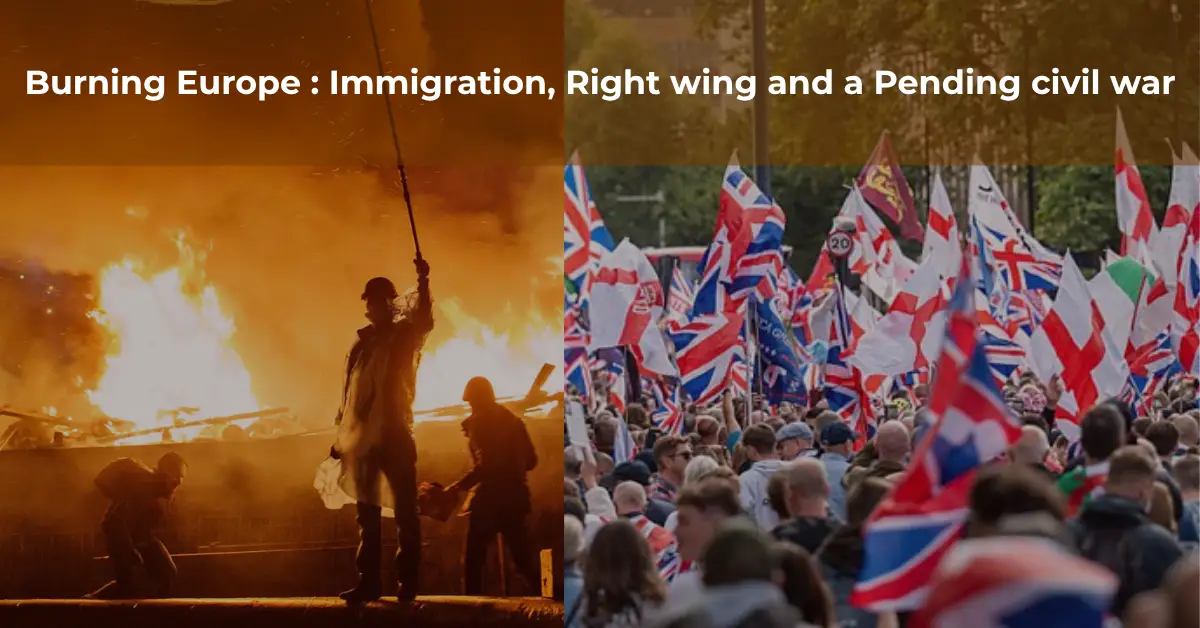
Europe immigration crisis is refusing to fade. What began as a humanitarian effort has spiralled into a political earthquake, reshaping elections, deepening cultural divides, and fuelling the rise of right-wing politics across the continent. From Paris to Berlin, the debate is no longer about whether immigration is a challenge, it’s about whether Europe can even hold itself together under the strain.
The refugee waves of the last decade promised “diversity and growth,” but the reality on the ground has been far more chaotic: parallel communities, growing crime statistics in some regions, and street-level unrest. Governments insist on solidarity, yet ordinary citizens see their neighbourhoods changing overnight, while Brussels remains tone-deaf to the mounting frustration.
This tension has cracked open the political map. Right-wing movements once dismissed as fringe now command millions of votes, gaining ground in Germany, France, Italy, and beyond. Their message is simple: if the establishment won’t protect Europe, then someone else will.
The danger is clear. When immigration and politics collide this violently, history shows that civil unrest isn’t a distant possibility, it’s the logical next step. And if Europe continues on this trajectory, whispers of a potential civil war may no longer sound like exaggeration.
Table of Contents
Crusades to WW2 : An introduction to violence
Europe’s history is steeped in centuries of violent conflict, many of which were driven by religion, ethnicity, and territorial ambition. From the Crusades of the Middle Ages to the world wars of the 20th century, these struggles forged not just borders, but a deeply ingrained culture of violence that still echoes in today’s politics.
Crusades and Medieval Violence
The Crusades (1096–1291) were a series of brutal religious wars fought primarily between European Christians and Muslim states in the Middle East. These campaigns were not just military ventures, they were cultural and religious clashes that left a legacy of distrust between civilisations. They also shaped Europe’s self-identity as defenders of “Christendom,” a concept that later evolved into exclusionary and supremacist thinking.
Religious Wars and Ethnic Conflicts
After the Crusades, Europe remained a battleground of faith and ethnicity. The Thirty Years’ War (1618–1648) tore apart Central Europe, killing millions and deepening religious division between Catholics and Protestants. Centuries of inter-state warfare, colonisation, and exploitation normalised violence as a tool of power and survival.
The Rise of Racial Theories and White Supremacist Thought
By the 19th century, Europe’s violent history merged with a new kind of ideology, the racial theory. Scientific racism and eugenics began to shape European politics, paving the way for modern white supremacist thought. This ideology claimed certain races were superior, justifying colonialism and oppression. These ideas were not fringe, they influenced governments, academia, and even humanitarian policy.
World Wars and the Radicalization of Europe
World War I and especially World War II cemented the violent streak in Europe’s collective psyche. The brutality of total war, the Holocaust, and the rise of fascism showed how deadly nationalism, racial ideology, and political extremism could become. Post-war Europe was left fractured, suspicious of outsiders, and yet grappling with a new openness, especially in immigration policy.
This violent history is not a relic of the past. It shaped the rise of right-wing politics in Europe today and explains much of the fear and resistance surrounding immigration. Understanding this history is essential to grasp why Europe’s immigration crisis is more than a policy problem, it is a cultural and existential one.
Post WW2 : Disastrous policies of the left wing
Why did the Europe turned left?
After the devastation of World War II, Europe faced massive reconstruction. Millions had died, cities were destroyed, economies were in ruins. Political thinking shifted dramatically. The horrors of fascism, nationalism, and war made many Europeans look for an alternative: and hence, rose social democracy and left-wing policies.
This shift was driven by:
- Desire for peace and cooperation: left-leaning politics promoted internationalism and solidarity, aiming to prevent another catastrophic war.
- Welfare state expansion: to rebuild economies and support citizens, governments introduced welfare policies, healthcare, education, and worker protections.
- Anti-fascism: the left associated nationalism and exclusion with fascist regimes, so it promoted exclusivity and human rights.
By the 1970s, this shift became cultural too: European politics, especially in countries like Sweden, Germany, and the UK, leaned toward multiculturalism and progressive values. This does not meant that the white supremacists and fascists were completely finished, they became dormant, less relevant and socially unacceptable. Majority of the society adopted left values, Right wing was less popular but still some the ideas were widely accepted and supremacists were minority.
Why Did Europe Start Accepting Immigration?
Europe’s post-war economy faced a big problem: labour shortages. Cities were rebuilding, industries needed workers, and population losses from the war meant there were fewer citizens to fill those jobs. The solution: inviting immigrants, initially from poorer European regions and later from former colonies.
Key immigration waves:
- 1950s–60s: Gastarbeiter (“guest workers”) from Turkey, Italy, Greece, and North Africa came to Germany, France, and Belgium to rebuild.
- 1970s–80s: Immigration expanded to include North Africa, South Asia, and former colonies, partly due to decolonisation.
- 1990s–2000s: EU expansion brought workers from Eastern Europe.
- 2015 onward: Refugee crisis : millions fleeing war zones like Syria, Afghanistan, and parts of Africa.
The left-wing justification for immigration:
- Promote equality and diversity.
- Uphold humanitarian principles.
- Counter population decline and labour shortages.
Left-Wing Blunders in Immigration Policy
The ideal of openness often collided with reality. Some mistakes include:
- Open borders without integration : Immigrants were welcomed but integration programs were weak or absent. Language, education, and employment opportunities often lacked coordination.
- Ignoring cultural tensions : Governments assumed multiculturalism would automatically work without addressing cultural differences.
- Neglecting security and assimilation : Some policies failed to address radicalisation and parallel societies.
- Over reliance on moral rhetoric : Left-wing governments often dismissed public concerns, fuelling resentment among native citizens.
These were some failures worth mentioning but beyond these policy failures, there lies some more deep reasons. Until the 1980s, immigration seemed successful. Guest-worker programs in Germany, France, and the UK brought millions of migrants from Turkey, Italy, Greece, North Africa, and former colonies. These workers filled labour shortages, paid taxes, and contributed to economic growth. For decades, immigration was largely framed as a win-win arrangement.
But cracks began to form when integration failed. Immigrant communities often lived in segregated enclaves, ghettos, attended separate schools, and maintained cultural practices that kept them apart from mainstream society. Language barriers, religious differences, and a lack of state-driven integration programs widened the divide. Slowly, immigrant communities grew in size and influence. By the 1990s, they had become a politically significant vote bank in several European countries.
This shift changed the narrative. What began as multiculturalism and as a vision of diversity and inclusion, transformed into a challenge of coexistence. Native Europeans were unwilling to take on the labour work that immigrant communities filled, and immigrants resisted abandoning their cultural enclaves. As a result, what was once a controlled process became an unstoppable crisis of integration. Up until These policy failures created the conditions for today’s Europe immigration crisis and fed the rise of right-wing populism.
Post 2000s blunder and current immigration trends
The final nail in the coffin arrives post-2000 period and brought a sharp escalation. Multiple factors converged to create a crisis: the Arab Spring, ongoing wars in Syria and Iraq, political instability in Africa, and large-scale migration pressures. Western Europe opened its doors to refugees driven by a combination of humanitarian duty, economic calculations, and political ideology.
Three main factors drove acceptance of refugees after 2000:
- The “White Man’s Burden” mentality : a lingering sense among Western liberals that Europe had a moral obligation to intervene and rescue displaced populations.
- Cheap labour needs : industries lobbying for migrant labour to fill low-wage jobs.
- Moral and humanitarian values : the idea that Europe must be a safe haven for refugees became a political ideal, reinforced by media narratives and civil society campaigns.
The Arab Spring in 2010 triggered a new migration wave, especially from Syria, Libya, and North Africa. The refugee crisis of 2015, when over a million people arrived in Europe, was a turning point. Borders became overwhelmed, integration policies collapsed in many places, and tensions flared.
Today, Europe is facing a multi-layered immigration crisis:
- Refugee flows continue unabated.
- Large immigrant populations have political influence but remain socially isolated.
- Failed integration and cultural friction feed rising anti-immigration sentiment.
- Immigration is now a central issue in politics, fuelling the rise of right-wing movements.
Current numbers:
- Around 5 million refugees currently in EU countries (2025 estimate).
- Majority in Germany, France, Italy, Spain, and Sweden.
- Significant illegal migration through Mediterranean routes, Balkan passages, and Eastern borders.
Illegal Immigration Routes and Refugee Demographics
- Mediterranean Sea route — dangerous journeys from North Africa to Italy, Spain, and Greece.
- Balkan route — Serbia, Bosnia, and Croatia as entry points to Western Europe.
- Eastern Europe route — refugees crossing from Ukraine, Belarus, or Russia.
Demographics:
- Many refugees are young men (often single), heightening integration and security challenges.
- A significant portion comes from Islamic-majority countries, which influences cultural tensions.
These trends make Europe’s immigration crisis not just a policy challenge, but a deep cultural and political fault line, one that could determine the continent’s stability for decades to come. They are now a significant vote bank and influence the politics and society of Europe.
Mindset of the immigrants and the left
“There will come a day when we see far more radicals, extremists and terrorists coming from Europe because of (a) lack of decision-making, and trying to be politically correct, and thinking that they understand Islam and Muslims better then we do” – Spoken by UAE’S foreign minister, these golden words are turning out to be a reality. While official reports and media narratives focus on economics and humanitarian needs, the cultural and ideological dimension often gets brushed under the rug. But ignoring it is precisely what has turned immigration from a manageable challenge into a continent-shaking fault line.
1. Refusal to Truly Integrate
Large immigrant groups often reject the idea of adapting fully to European society. Learning the language, adopting local values, or embracing secular law is seen not as a path to success, but as a betrayal of their roots. Instead of becoming multicultural in the genuine sense i.e blending into and enriching European society, many cling tightly to their own traditions, customs, and worldview. The result: a Europe within Europe that refuses to dissolve into the host culture.
2. The Parallel Society Mentality
Across Europe, immigrant communities have created parallel societies, self-contained environments where religious law, traditional practices, and community rules override the nation’s institutions. These enclaves deepen the “us versus them” divide. For outsiders, they are opaque and often hostile; for insiders, they reinforce suspicion toward the larger society. In the long run, this mentality fragments nations into disconnected islands of identity.
3. Indoctrination Through Religious Authority
Radical preachers, madrassas, and ideological leaders play a huge role in shaping immigrant communities, particularly among second-generation youth. Instead of encouraging integration, they invoke Hadith and religious rulings to argue that Muslims must resist assimilation into “infidel” societies. This religious indoctrination fosters resentment, victim hood, and, in the worst cases, jihadist ideology. This ideology has created an eco-system in Europe to pass the same indoctrination to the upcoming generations
4. Victimhood and Political Weaponization
The immigrant identity has also been politicised and weaponized. Left-leaning parties, hungry for a stable voter base, treat immigrant populations as a guaranteed vote bank. In return, grievances and victim hood narratives are amplified: discrimination, colonial guilt, Islamophobia. This cycle ensures that communities remain politically relevant but socially detached, making assimilation an even lower priority.
Problems caused by the radicals
Rise of the right wing
The problems created by radicalised immigrants have reshaped European politics. What was once a fringe, taboo conversation is now mainstream. Across the continent, parties once dismissed as “far-right” or “xenophobic” are coming into power.
1. From Fringe to Mainstream
- In France, Marine Le Pen’s National Rally has gone from being unelectable to a dominant force, shaping the national agenda on immigration.
- In Germany, the AfD (Alternative für Deutschland) is steadily climbing in popularity, capitalizing on resentment against Merkel-era refugee policies.
- In Italy, Giorgia Meloni has already taken power, promoting strong borders and national identity.
- In Hungary and Poland, Orban and Law & Justice have made nationalism a governing ideology.
What unites these movements is not traditional conservatism, but a sharp response to unchecked immigration, cultural disintegration, and the failure of centrist politics.
2. Why Right-Wing Populism Appeals
- Security over tolerance: Citizens no longer want abstract values of “humanitarianism” if their daily safety is at stake.
- Economic realism: Native workers see immigrants as both welfare competitors and job takers.
- Cultural pride: A pushback against what many view as leftist guilt and “white man’s burden.”
- Rejection of multiculturalism: Europeans increasingly demand assimilation, not parallel societies.
3. The Backlash Cycle
Every riot, terror attack, or migrant-related crime strengthens the argument of the right-wing: that Europe is at risk of losing itself. This is not just politics anymore, it’s survival.
Future of Europe : upcoming civil war
It is not a rhetoric or sensational headline, European civil war is inevitable. It is not a matter of time, it is a matter of when. Tommy Robinson’s rally in the UK had over 150,000 people which were not right wingers, they were fascists. The slogans raised, were calling out for eradication of Islam. The speeches were hate speeches, and masses might not support it, but they will not deny it or oppose it.
In the next 3-5 years, As early as 2028-2029, Europe might see massive blood bath. An inflection point have been reached, where both the sides are not ready to back down. The more crimes, terror attacks and riots happen by the immigrants, the more Europe goes closer to a civil war.
Scenarios for the Next Decades
- Controlled Crackdown: Right-wing governments take over and enforce harsh immigration laws, forcing assimilation or deportations.
- Escalating Street Violence: Clashes between radicals and natives spiral into near-daily unrest.
- Fragmented States: Nations like France or Belgium could see de facto partitioned zones, where state authority does not fully apply.
- Civil War-lite: Not a formal war, but ongoing insurgency-style conflict across urban centers.
NRI(s) : The new weevils
After the 9/11 attacks, Kids as young as 2 years old were killed who looked like Afghans and Indian Sikh’s, Pathan’s wearing turbans were shot randomly at streets. NRIs have seen killings and hate speeches, recent example being Ireland and The UK.
In Ireland, 6 year old girl was attacked in-front of her home. A 40 year old man was stabbed and robbed. When the hate will spill over, It will not differentiate between Indian, Pakistani or legal or illegal migrants. Your skin colour will be looked at, and your fate will be decided.
The next section is harsh and a warning to the NRIs. If it hurts your feelings, then I am sorry, you might be one of them whom I describe. I have to be blunt. The sole reason of the rising hate against Indian migrants is lack of self confidence, seeking acceptance and validation and avoiding confrontation maybe backed by greed. The NRIs try to be “more loyal then the king”, acting more European then the European themselves. Grooming gangs are operated by Pakistani men, but they are never called Pakistani, they are called “South Asian”. The lack of self respect, greed and their silence over the hate against NRIs will cost a heavy price.
I appeal to the NRIs that whenever you face racism, or see hate crime or targeted campaigns against India, stand up and raise your voice either by Social media, pressuring your representatives or peaceful protests, otherwise, there will be a day when you will regret this silence and will have to return to the India you hate.
Conclusion
In the end, Europe’s coming time does not looks peaceful, It is stuck in a backlash cycle. Either the right wing governments act as pressure valves and enforce strict laws to control the violence and deport immigrants, or violence spills over to a daily street killings and mass civil unrest. At last I would say that the history of crusaders up until WW2 made Europe peaceful, their today will make them crusaders again.
Read also : Ladakh violence analysis